Facials 101: What a Facial Really Does and How to Choose the Right One
A clear, science-grounded guide to what facials do for your skin, the main types, how often to get them, and how to pick the right one.
Your scalp is the soil your hair grows from. Here's what a salon scalp treatment can and can't, do, explained simply.
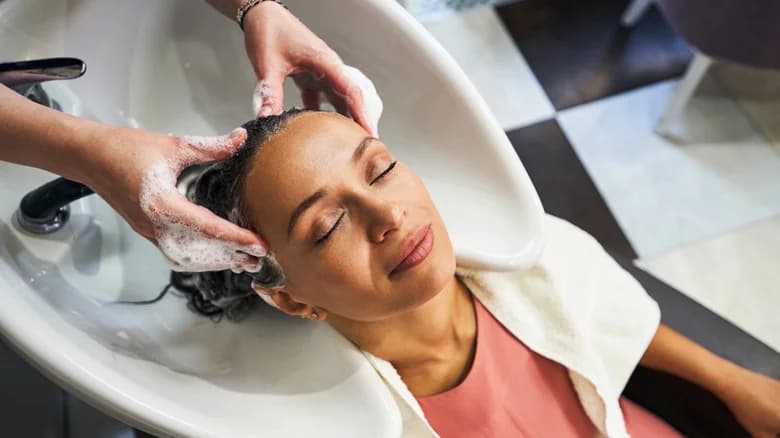
We obsess over our hair, colour, cut, smoothing, styling and almost completely ignore the place it actually grows from. Yet a flaky, itchy, oily or congested scalp affects how your hair looks and feels every single day. A professional scalp treatment is one of the most underrated services in a salon. This guide explains, honestly, what it does for you and what it can't.
The simple idea
Think of your scalp as soil and your hair as the plant. Healthy soil grows healthier-looking plants. A scalp treatment cleans, exfoliates and soothes that soil, improving comfort and the condition of your scalp and hair. What it is not is a medical cure for serious hair loss, and any honest salon will tell you so.1,8
Your scalp carries one of the highest densities of hair follicles and oil (sebaceous) glands on your whole body. Each hair grows from a follicle, fed by oil that lubricates and protects the skin. The scalp is also home to a delicate ecosystem of microbes, a 'microbiome', that, when balanced, helps keep things healthy. When that balance is disrupted, problems like dandruff tend to follow.2,3 So scalp care isn't a luxury add-on; it's basic maintenance for the environment your hair lives in.
Flaking and dandruff. Often driven by a yeast that naturally lives on the scalp, plus oil and individual sensitivity, not simply 'dryness.'3
Oiliness and buildup. Sweat, styling products, dry shampoo and pollution accumulate on the scalp, leaving hair limp and the scalp congested.1
Itch and discomfort. A common symptom of buildup, flaking or an unbalanced scalp.3
That 'heavy, unrefreshed' feeling, especially in a hot, humid, dusty city, where scalps get grimy fast.
A professional scalp treatment typically combines gentle cleansing, exfoliation to lift buildup and dead skin, a relaxing massage, and targeted soothing or balancing products, leaving your scalp genuinely cleaner, calmer and more comfortable.
Yes, with appropriate honesty about how strong that science is. A few well-supported points:
Scalp massage has promising evidence. In a small controlled study, men who received a standardised daily scalp massage for 24 weeks showed increased hair thickness, and lab work suggested the gentle stretching forces influence the cells at the base of the follicle.4 A larger self-reported follow-up found many people felt their hair stabilised or improved with regular massage.5 These studies are small and preliminary, massage is safe and plausible, not a guaranteed regrowth treatment.
Keeping the scalp clean and balanced matters. Dermatology guidance supports cleansing the scalp (not just the lengths) and clarifying periodically if you use a lot of product.1
A balanced scalp microbiome is linked to scalp health, while imbalance is associated with dandruff.2
What we promise and what we don't
A scalp treatment can reliably reduce flaking, buildup and oiliness, soothe itch, and leave your scalp cleaner and more comfortable. It cannot reverse genetic hair loss or replace medical treatment. We'd rather set honest expectations than overpromise.1,8
Anyone with an oily scalp, product buildup, or mild flaking and itch.1
People who want a maintenance and relaxation ritual for scalp wellbeing.
Those using lots of styling products, or living in humid, polluted, dusty conditions.
Anyone wanting supportive care alongside a dermatologist's hair-loss treatment (as a complement, not a replacement).8
Not sure whether a scalp treatment is for you? These everyday signs usually mean your scalp would benefit:
Your scalp feels oily or 'heavy' within a day of washing, or your roots go flat quickly.
You notice small flakes on your shoulders or in your hair, or mild, occasional itch.3
Your hair feels coated or dull despite regular washing. A classic sign of product buildup.1
You use a lot of styling products, dry shampoo, or spend long days in heat, dust and pollution.
Your scalp simply feels tight, irritated or 'unrefreshed' and you want it to feel clean and calm again.
None of these are medical emergencies, they're exactly the comfort-and-condition issues a scalp treatment is designed to address.
A scalp treatment is for comfort and condition, not for diagnosing medical problems. Please see a dermatologist if you have:
Sudden, patchy or rapidly progressing hair loss.7
Painful, pus-filled spots, spreading redness, or thick scaly plaques.
Persistent severe itch or bleeding, or flaking that doesn't improve with care.3
It's also worth knowing that some shedding is normal and often temporary, for example, stress, illness or major life events can trigger a diffuse, usually reversible shedding called telogen effluvium, which typically settles once the trigger passes.7 If you're worried, a dermatologist can tell you what's going on.
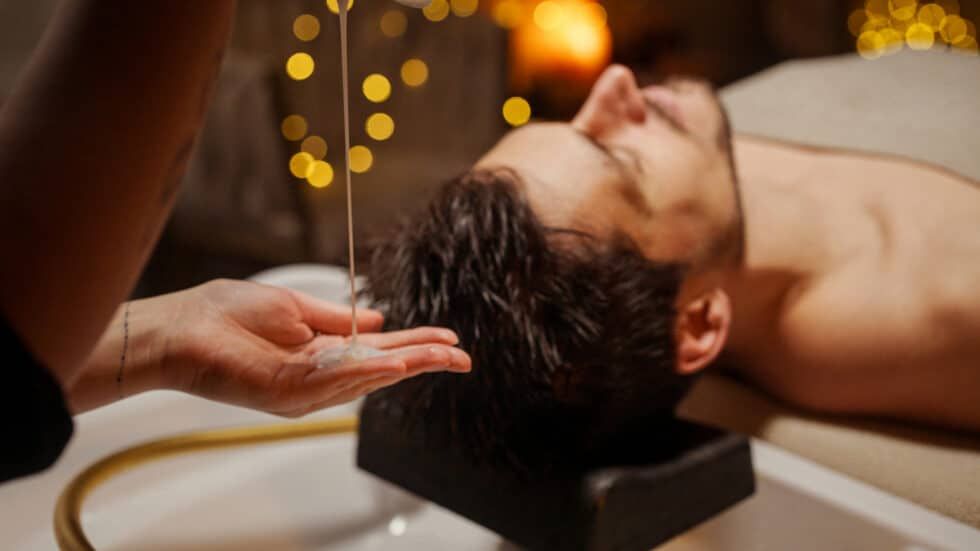
A professional scalp treatment is as relaxing as it is practical. While details vary by your needs, a typical session includes:
Scalp assessment. We look at your scalp's condition, oiliness, flaking, sensitivity, buildup and ask about your concerns and routine.
Cleanse. A thorough, often clarifying cleanse to clear oil, sweat and product residue.1
Exfoliation. Gentle lifting of dead skin and buildup from the scalp surface.1
Massage. A relaxing scalp massage, pleasant in itself, and supported by preliminary evidence linking regular massage to improved hair thickness.4
Targeted care. Soothing or balancing serums or masks suited to your scalp, sometimes with steam.
Advice. Simple guidance to keep your scalp healthy between visits.
Most people leave feeling that their scalp is genuinely cleaner, lighter and calmer and the massage portion alone is worth the visit.
"Flakes always mean a dry scalp." Often the opposite, dandruff is commonly driven by a scalp yeast and oil, and frequently occurs on oily scalps.3
"Washing less is always better for your scalp." Not necessarily, oily scalps can need more frequent washing, and leaving buildup can cause irritation. It's about matching washing to your scalp.1
"A scalp treatment will regrow lost hair." It supports scalp health and comfort but can't reverse genetic hair loss. That needs a dermatologist.8
"Scalp care is only for people with problems." Regular maintenance keeps a healthy scalp healthy, much like regular skincare.
Wash to suit your scalp, oilier scalps need more frequent washing, drier ones less; apply shampoo to the scalp, not just the lengths.1
Clarify occasionally if you use a lot of product, to clear buildup.1
Be gentle, over-washing and harsh scrubbing can irritate and dry out the scalp.1
Look after the basics, balanced diet, hydration and stress management support overall scalp and hair wellbeing (and if you suspect a nutritional deficiency, get it tested rather than guessing).
A professional scalp treatment is a genuinely worthwhile way to keep the foundation of your hair clean, balanced and comfortable and it feels wonderful. The key is honest expectations: it supports scalp health and complements medical care, rather than replacing it.
Curious whether your scalp would benefit? Book a scalp consultation at Diana & Dapper. We'll assess your scalp, talk through your concerns, and recommend the right treatment, or, if something needs medical attention, point you in the right direction.
1. American Academy of Dermatology (AAD). Tips for healthy hair and scalp care. https://www.aad.org/public/everyday-care/hair-scalp-care/hair/healthy-hair-tips
2. Comparison of healthy and dandruff scalp microbiome: the role of commensals. PMC, 2018. https://pmc.ncbi.nlm.nih.gov/articles/PMC6180232/
3. Seborrheic dermatitis and dandruff: a comprehensive review. PMC, 2015. https://pmc.ncbi.nlm.nih.gov/articles/PMC4852869/
4. Koyama T et al. Standardized scalp massage increases hair thickness via stretching forces on dermal papilla cells. Eplasty, 2016. https://pmc.ncbi.nlm.nih.gov/articles/PMC4740347/
5. English RS et al. Self-assessments of standardized scalp massage for androgenic alopecia: survey results. Dermatol Ther, 2019. https://pmc.ncbi.nlm.nih.gov/articles/PMC6380978/
6. StatPearls (NCBI). Physiology of hair and the hair growth cycle, 2023. https://www.ncbi.nlm.nih.gov/books/NBK499948/
7. Telogen Effluvium. StatPearls (NCBI), 2023. https://www.ncbi.nlm.nih.gov/books/NBK430848/
8. Medical and procedural treatment of androgenetic alopecia, where are we? JAAD, 2023. https://www.jaad.org/article/S0190-9622(23)00768-5/fulltext
A note on this article
This article is for general education and is based on the cited scientific and regulatory sources. It is not medical advice. Results vary by individual; for any medical scalp or hair condition, please consult a qualified dermatologist. At Diana & Dapper we are happy to discuss your hair and scalp history before recommending any service, book a consultation to learn what is right for you.
Ready to book?
Sainikpuri and Malkajgiri. Walk-ins always welcome — no appointment needed.
Browse all articles or explore by topic below.
A clear, science-grounded guide to what facials do for your skin, the main types, how often to get them, and how to pick the right one.
What a keratin treatment really does, who it suits, and how to decide, explained simply, backed by science.
A friendly, honest guide to hair smoothening, what it is, how it differs from keratin and rebonding, and how we keep it safe.
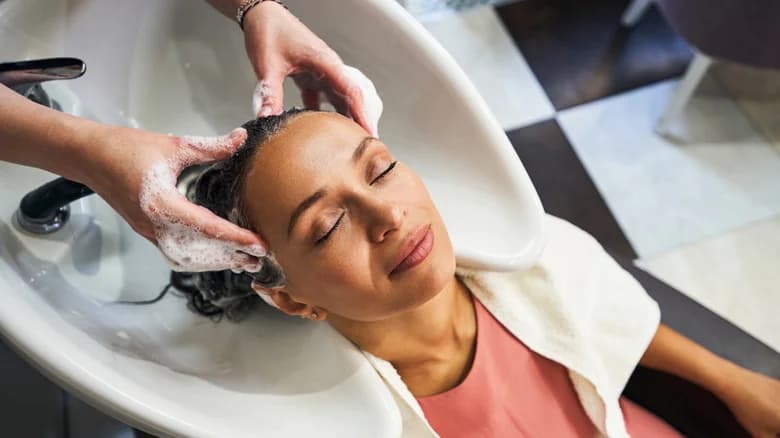
Your scalp is the soil your hair grows from. Here's what a salon scalp treatment can and can't, do, explained simply.
A friendly guide to the quick add-on treatments worth booking alongside your facial or hair appointment and how to get the best results.
Your guide to professional facials and why your face deserves the very best care