Facials 101: What a Facial Really Does and How to Choose the Right One
A clear, science-grounded guide to what facials do for your skin, the main types, how often to get them, and how to pick the right one.
How advanced facials work at the level of skin biology, the mechanisms, the strength of the evidence, and where the limits really are.
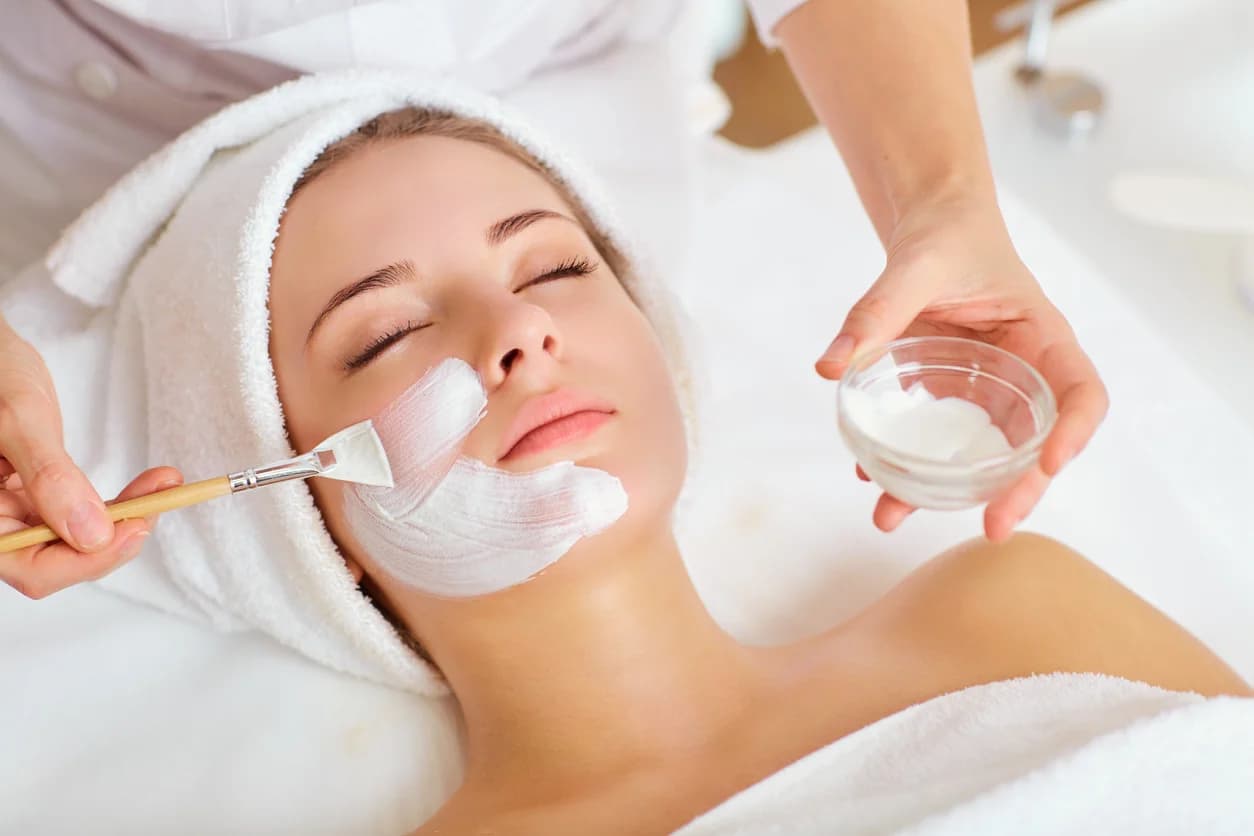
Advanced facials promise more than a classic facial, and the good ones genuinely deliver but for different reasons than the marketing usually gives. If you want to understand what's actually happening to your skin during a peel, a hydradermabrasion, an LED session or an actives-led facial, and how strong the science really is for each, this is the deep dive.
Your epidermis continuously renews itself: cells form at the base, migrate up, and shed from the surface over roughly 28 days, longer with age.1 Most advanced facials work by influencing this renewal, accelerating controlled exfoliation, stimulating the deeper skin to rebuild, or delivering active molecules that change how skin cells behave. The 'advanced' part is precision: stronger, more targeted intervention than a classic facial, which is exactly why technique and professional judgement matter so much.
A peel applies an acid that breaks the bonds between surface skin cells, removing outer layers in a controlled, even way and prompting renewal. The chemistry divides into two main families: alpha-hydroxy acids (AHAs) such as glycolic acid, which are water-soluble and work on the surface to loosen dead cells and brighten; and beta-hydroxy acids (BHAs) such as salicylic acid, which are oil-soluble, so they penetrate sebum-filled pores, making them especially effective for acne.2
The evidence is robust. A systematic review of randomised controlled trials supports chemical peels for acne, and salicylic acid in particular is regarded as a gold-standard superficial peel for mild-to-moderate acne.4 Glycolic acid is well documented across acne, pigmentation, melasma and photoageing.3 Peels are classified by depth, and the safety message from the literature is clear: superficial and medium-depth peels are safe in trained hands; deep peels carry real risks and belong to specialists.2 A salon peel is a superficial peel.
Hydradermabrasion uses a water-based vortex to exfoliate while simultaneously infusing hydrating and antioxidant serums. Its mechanistic advantage over older microdermabrasion is that it resurfaces without the micro-tears, so it stimulates cell turnover more gently and can be repeated more often.5 Histological work on hydradermabrasion has documented increased epidermal and papillary dermal thickness, higher antioxidant levels, and increased fibroblast density, i.e. measurable structural changes, not just a surface polish.5
Microdermabrasion physically abrades the stratum corneum with crystals or a diamond tip. An evidence-based review confirms it can change dermal-matrix constituents and improve skin contour and texture but concludes its role in pigmentation and acne is limited.6 The honest scientific read: a reliable tool for texture and smoothness, a weaker one for pigment and breakouts, where peels and actives outperform it.
LED facials are an application of photobiomodulation, specific light wavelengths absorbed by cells to alter their activity. Blue light (≈415 nm) acts on the upper skin and has antimicrobial effects against acne-causing bacteria; red light (≈630–660 nm) penetrates deeper and modulates inflammation and supports collagen activity.7,8 A systematic review and meta-analysis supports LED's role in skin therapy, with red light improving wrinkles and photodamage and blue/red combinations helping acne.7
The crucial scientific caveat is dose-dependence: outcomes hinge on wavelength, fluence, irradiance and session parameters, and many consumer devices are cleared for safety rather than demonstrated efficacy. Professional-grade equipment, correct wavelengths and adequate dosing are what separate a working treatment from a pleasant red glow.7
Some of the strongest evidence in skincare is for specific molecules, which advanced facials can deliver in professional concentrations:
Vitamin C (L-ascorbic acid) is a potent antioxidant that neutralises free radicals, is required as a cofactor for collagen synthesis and stabilisation, and inhibits melanin formation, translating to protection, firmer-looking skin and brighter tone. Its practical limitation is formulation: it's unstable and penetrates skin poorly unless well formulated.9
Retinoids are vitamin-A derivatives that bind nuclear receptors and directly change gene expression in skin cells, increasing turnover, stimulating collagen and reducing its breakdown. Topical tretinoin is the clinical gold standard for photoageing, with systematic-review support for reducing wrinkles and improving texture and pigmentation; retinol is the gentler over-the-counter form.10 (Not for use in pregnancy.)
Niacinamide (vitamin B3) is a versatile, well-tolerated agent that supports the skin barrier, reduces transepidermal water loss, helps regulate sebum, and improves pigmentation and the look of fine lines.11
Every resurfacing or renewing treatment temporarily leaves newer, more vulnerable skin at the surface, and UV exposure both darkens pigment and degrades collagen. That's why dermatology consistently frames daily broad-spectrum sunscreen as the foundation that protects and prolongs, the results of any advanced facial.12 Skipping it doesn't just risk undoing a treatment; for pigmentation it can actively reverse it.
Concern | Mechanism that fits | Strength of evidence |
|---|---|---|
Acne / congestion | Salicylic (BHA) peel; blue/red LED | Strong / supportive4,7 |
Pigmentation / tan | Glycolic (AHA) peel; vitamin C; retinoids | Strong3,9,10 |
Fine lines / ageing | Retinoids; red LED; vitamin C | Strong / supportive10,7,9 |
Texture / dullness | Microdermabrasion; hydradermabrasion | Mixed / supportive6,5 |
Hydration / glow | Hydradermabrasion; niacinamide | Supportive5,11 |
Advanced facials are not interchangeable, and 'advanced' is not a synonym for 'better for everything.' The science points to clear strengths: peels and actives have the deepest evidence base, hydradermabrasion and LED are well supported, and microdermabrasion is best kept to texture. The smartest plan matches the mechanism to your concern, uses a sensible course rather than a single session, respects skin safety (superficial peels only at salon level), and is anchored by daily sunscreen.
Our approach
At Diana & Dapper we choose advanced treatments by mechanism and evidence, not by what sounds impressive and we're glad to explain exactly how a treatment will work on your skin before you commit. For concerns that need medical-grade intervention, we'll point you to a dermatologist.
1. SEER Training Modules (NCI). Layers of the Skin and cell turnover. https://training.seer.cancer.gov/melanoma/anatomy/layers.html
2. A Practical Approach to Chemical Peels: Review of Fundamentals. PMC, 2018. https://pmc.ncbi.nlm.nih.gov/articles/PMC6122508/
3. Glycolic acid peel therapy, a current review. PMC, 2013. https://pmc.ncbi.nlm.nih.gov/articles/PMC3875240/
4. Chemical peels for acne vulgaris: a systematic review of RCTs. PMC, 2018. https://pmc.ncbi.nlm.nih.gov/articles/PMC5931279/
5. Freedman BM. Hydradermabrasion: an innovative modality for nonablative facial rejuvenation. PubMed, 2008. https://pubmed.ncbi.nlm.nih.gov/19146604/
6. Microdermabrasion: an evidence-based review. PubMed, 2010. https://pubmed.ncbi.nlm.nih.gov/20048628/
7. Ngoc et al. Utilization of LEDs for skin therapy: systematic review and meta-analysis. Photodermatol Photoimmunol Photomed, 2023. https://onlinelibrary.wiley.com/doi/10.1111/phpp.12841
8. Unlocking the Power of Light on the Skin: A Comprehensive Review on Photobiomodulation. Int J Mol Sci, 2024. https://www.mdpi.com/1422-0067/25/8/4483
9. Topical Vitamin C and the Skin: Mechanisms of Action and Clinical Applications. PMC, 2017. https://pmc.ncbi.nlm.nih.gov/articles/PMC5605218/
10. Topical tretinoin for treating photoaging: a systematic review of RCTs. PMC, 2022. https://pmc.ncbi.nlm.nih.gov/articles/PMC9112391/
11. Niacinamide: A Multi-functional Cosmeceutical Ingredient (review). Practical Dermatology. https://practicaldermatology.com/topics/aesthetics-cosmeceuticals/niacinamide-a-multi-functional-cosmeceutical-ingredient/23720/
12. American Academy of Dermatology. How to select a sunscreen. https://www.aad.org/public/everyday-care/sun-protection/shade-clothing-sunscreen/how-to-select-sunscreen
A note on this article
This article is for general education and is based on the cited scientific sources. It is not medical advice. Advanced facials should be performed by trained professionals; medium-depth and deep peels and medical-grade procedures belong in a clinical setting, and retinoids are not for use in pregnancy. For persistent acne, pigmentation, scarring or any skin condition, consult a qualified dermatologist. At Diana & Dapper we assess your skin before recommending any advanced treatment.
Ready to book?
Sainikpuri and Malkajgiri. Walk-ins always welcome — no appointment needed.
Browse all articles or explore by topic below.
A clear, science-grounded guide to what facials do for your skin, the main types, how often to get them, and how to pick the right one.
What a keratin treatment really does, who it suits, and how to decide, explained simply, backed by science.
A friendly, honest guide to hair smoothening, what it is, how it differs from keratin and rebonding, and how we keep it safe.
Your scalp is the soil your hair grows from. Here's what a salon scalp treatment can and can't, do, explained simply.
A friendly guide to the quick add-on treatments worth booking alongside your facial or hair appointment and how to get the best results.
Your guide to professional facials and why your face deserves the very best care